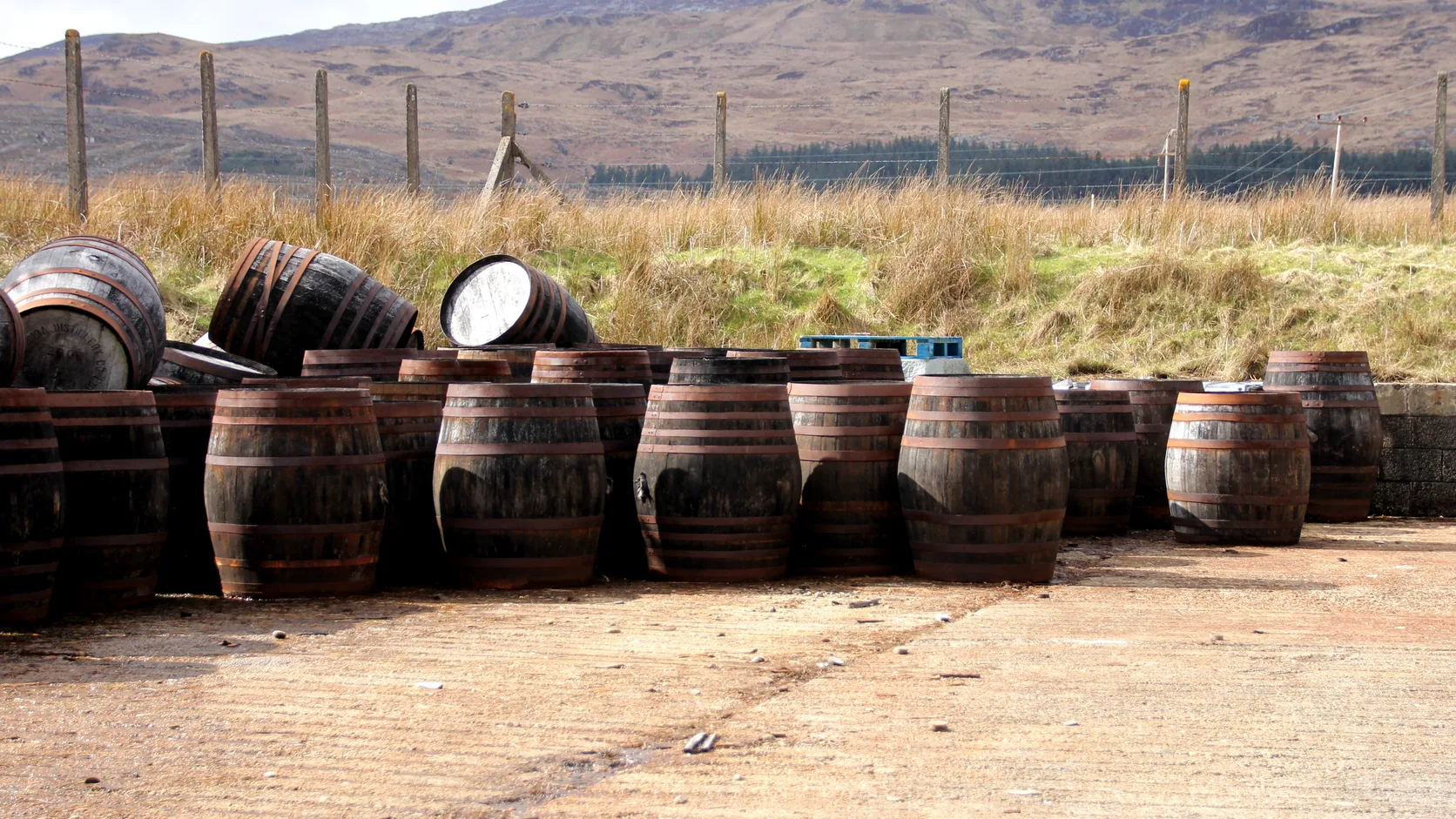
Maturation gives and takes at the same time
Spirit in a cask gains colour and aroma from the oak as the years pass. Over those same years its volume keeps falling. Oak is not a fully sealed material, so alcohol and water slowly work their way out through the grain.
The industry calls what disappears the angels' share. Explaining what a private cask owner should expect, the Scotch Whisky Association puts it plainly:
> The only certainty about owning a cask is that it will lose roughly 2% of its contents through evaporation each year. > — Scotch Whisky Association
Two per cent looks small in a single year. Maturation, however, compounds it.
| Age | Remaining at 2% per year |
|---|---|
| 3 years | about 94% |
| 12 years | about 78% |
| 18 years | about 69% |
| 25 years | about 60% |
| 30 years | about 55% |
A 25-year-old cask is bottled with roughly four bottles in every ten already gone. Ask why old whisky is expensive and the usual answer is "because someone waited." Half the answer is that there is simply less of it left.
> The table assumes a steady 2% per year. Real evaporation varies with the conditions described below, and losses are often larger in the first few years.
What drives the rate
Warehouse humidity
Whether alcohol or water leaves faster is governed by the humidity of the surrounding air.
- In a humid warehouse less water escapes and proportionally more alcohol does, so the strength drifts down over time.
- In a dry warehouse water evaporates faster, so the strength can hold steady or even rise.
Scotland is generally damp and cool, so Scotch casks tend to lose strength as they age. That is why the strength printed on an old cask-strength Scotch is often down in the high forties.
The legal floor matters here. Scotch Whisky must be at least 40% ABV, so once a cask drifts below that line it can no longer be bottled as Scotch.
Cask size
For the same volume, a smaller cask puts proportionally more wood surface in contact with the liquid. Smaller casks therefore mature faster — and evaporate faster too. Short finishes in quarter casks lean on exactly this property.
Warehouse type
A traditional dunnage warehouse, with an earthen floor and casks stacked only two or three high, tends to hold higher humidity. A racked warehouse with a concrete floor and tall steel racking runs drier. This is why casks from different warehouses — even different heights within one warehouse — are said to develop differently.
The legal frame around maturation
Evaporation is a natural process, but where and how long whisky matures is set out in law. Regulation 3 of The Scotch Whisky Regulations 2009 requires that Scotch Whisky be:
- matured only in oak casks not exceeding 700 litres
- matured for not less than three years
- matured in Scotland, in an excise warehouse or other permitted place
- bottled at a minimum strength of 40% ABV
The SWA adds that, by law, Scotch Whisky may only be matured in a warehouse in Scotland verified by His Majesty's Revenue and Customs. Buying a cask and maturing it at home is simply not possible under this system.
Around 22 million casks are maturing in warehouses across Scotland — roughly 12 billion 70cl bottles' worth.
How it shows up in the game
In Distillery Tycoon a cask yields fewer bottles the longer you leave it. That is the angels' share, carried straight across.
So the central judgement is not simply "older is better." An older whisky sells for more, but
- it yields fewer bottles,
- it occupies a warehouse slot the whole time, and
- it costs you the chance to fill that slot with something else.
"Do I bottle this at twelve years or hold it to twenty-five?" is a matter of weighing those three against each other — the same kind of calculation a real distillery makes every year.
How age itself feeds into price is covered in age statements, and what changes with each successive fill is in 1st-fill vs 2nd-fill.