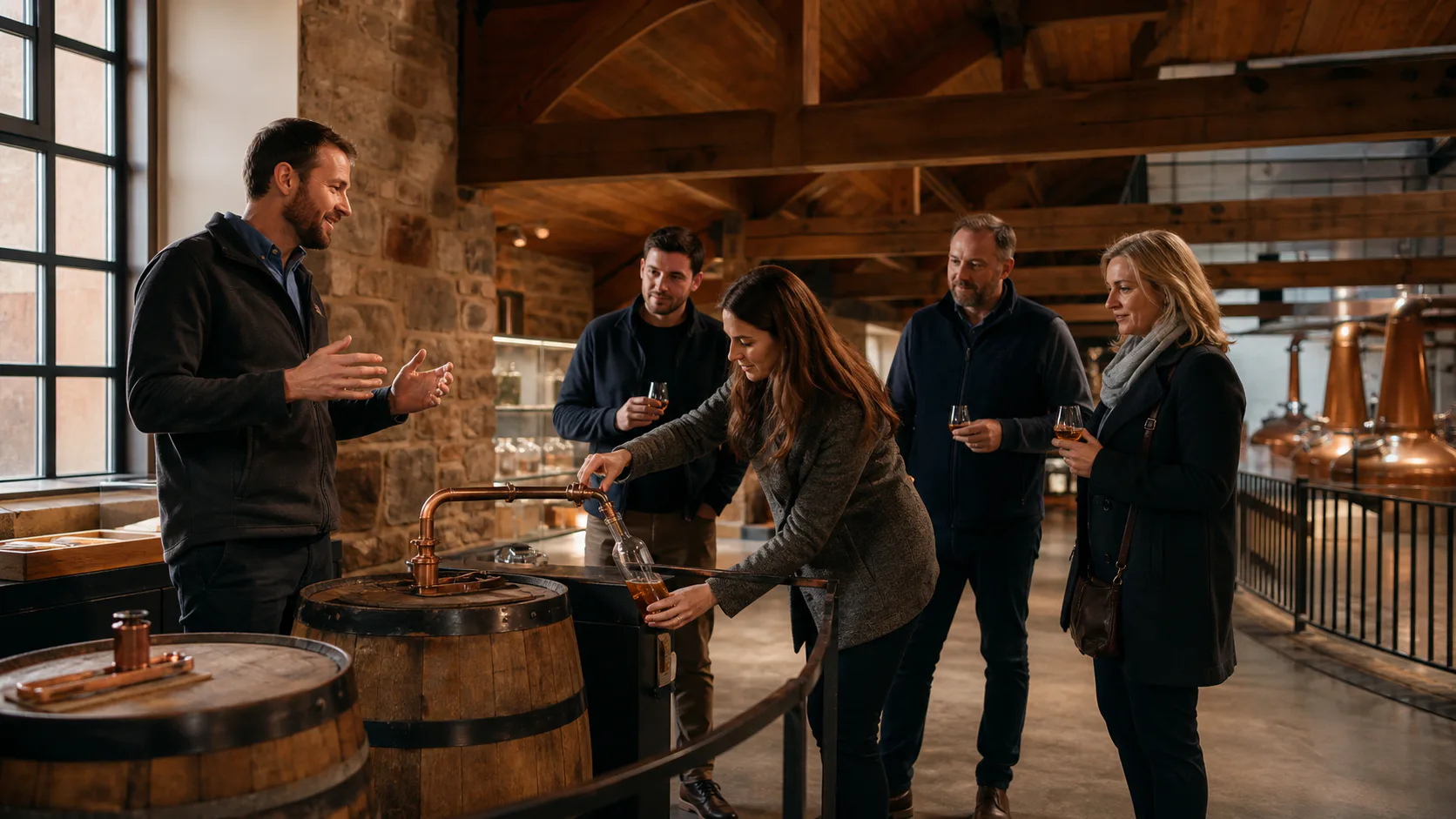
A distillery connects the choices behind the label
The strongest reason to take a distillery tour is not simply to look at machinery. Moving through the smell of a mash room, the sound of fermentation, the scale of copper stills and the cool oak air of a warehouse connects label vocabulary to a working place. Questions about why two whiskies of similar age and strength feel different become more specific once the visitor has seen how many production and maturation decisions sit behind them.
A good tour gives context rather than merely presenting a long tasting list. A guide can explain what is operating that day, why each piece of equipment matters and where visitors may safely pause to smell, look and ask questions. Someone who does not drink can still learn from the production, architecture, local history and sensory environment.
The visitor centre is the starting point
A visitor centre is more than a shop. It is where bookings, safety instructions, introductory displays, tastings, accessibility information and local travel advice meet. A working distillery changes with its production and maintenance schedule, so every space shown in a photograph may not be accessible on every visit.
Balblair's official visitor page combines tours of its buildings and makers with a visitor shop and a hand-bottling experience. Tomatin publishes its visitor-centre hours, travel and accessibility notes, bar information and bottle-your-own option together. Reading these details before arrival leaves more attention for the place itself rather than last-minute logistics.
Hand filling links the cask to a personal record
The phrases hand fill, fill your own and bottle your own generally describe an experience in which a visitor draws spirit from a selected cask, closes and seals the bottle, and completes its label. Unlike taking a standard release from a shelf, the point is to record the cask, strength and day of the visit while seeing how the liquid leaves its maturation vessel.
Balblair describes filling a bottle from a hand-selected cask, corking, sealing and labelling it before signing a ledger. Tomatin also advertises hand filling a cask-strength distillery exclusive. An official Talisker article describes a bottle-your-own experience in the distillery retail store. The available cask, age, strength, price and stock can all change, however. Treat an older trip report as inspiration and recheck the current official booking page.
Choose the tour around the question you want answered
| Tour type | Main focus | Best suited to |
|---|---|---|
| Introductory tour | Production route, stills, basic tasting | A first distillery visit |
| Production deep dive | Malt, fermentation, spirit cuts, plant operation | Visitors interested in process variables |
| Warehouse and cask tour | Maturation conditions, cask comparison, cask samples | Visitors focused on ageing and flavour |
| Hand-fill experience | Bottling, label completion, visit record | Visitors who want a site-specific keepsake |
More samples do not automatically make a better tour. Decide whether production, maturation, history or architecture matters most to you. When visiting several sites in a day, allow time for food, water and travel rather than stacking consecutive cask tastings.
Plan the booking and journey first
A distillery is an industrial workplace. There may be stairs, metal walkways, low ceilings and hot equipment. Check footwear and clothing requirements, photography restrictions, age rules and wheelchair access before booking. During a maintenance or silent season, parts of production may not be running even though tours continue.
Sites that appear close on a map may take much longer to connect by public transport. On islands and in rural areas, check the final ferry, bus and taxi times as carefully as the tour time. Leave a buffer after the tour for questions and delays. If you intend to bring home a hand-filled bottle, recheck airline baggage rules and the alcohol import rules of your destination at the time of travel.
Drivers and non-drinkers can share the visit
When travelling by car, the driver should not take the tasting. Tomatin explicitly offers included samples as takeaway “driver's drams,” providing a useful model for responsible visits. Where no equivalent is available, experience the aromas with water or a non-alcoholic drink and taste later after reaching the accommodation.
Ask what the tour offers companions who do not drink. Architecture, industrial heritage, local history and the contrast between new make and the warehouse environment can stand on their own. Prices and age restrictions vary, so they should always be checked with the individual operator rather than assumed from another distillery.
Record only three things afterwards
After the tour, do not try to memorise every equipment name. Record three things: the production choice the distillery emphasised most; the aroma that stood out in the warehouse or tasting; and one assumption that changed during the visit. Those notes become useful the next time you read a label or compare two whiskies.
A hand-filled bottle does not need to be opened immediately. Keep its cask information with the visit notes so that, whenever it is opened, it recalls people and place rather than functioning only as a scarce release. That connection is the longest-lasting part of a distillery tour.