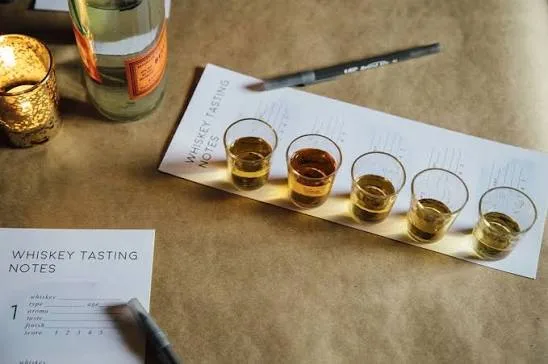
Tasting notes go stale within days not because they lack eloquence, but because they capture only that day's mood — "fragrant," "smooth," "delicious" — while dropping the conditions and the changes. A good note isn't the one that reads like an expert wrote it; it's the one you can actually compare against the next bottle.
Fix your conditions before you start writing
Use a similar glass shape, a similar pour, and a similar resting time whenever you can. Glass, temperature and how long a dram sits in the glass all affect its aroma. You don't need lab-grade consistency every time, but it's worth jotting down things like "right after dinner," "first day of opening," or "rested about 15 minutes."
Judgement drifts easily right after strong-smelling food or perfume. Don't force a score on a bad day, either. A note like "stuffy nose — hold off on aroma scoring" isn't a failed entry; it's a booking for a re-taste.
Spend your time on aroma, taste and finish, not colour
Colour is worth observing, but don't turn it into a guessing game for age or quality — cask, added colour, and lighting all affect it. Something like "pale gold" is enough; move on to aroma.
For aroma, rather than plunging your nose in for one strong sniff, try varying the distance a little at a time. If the alcohol hits hard at high strength, pull back for a moment. Note your first impression, then come back about five minutes later — you'll be able to tell what faded and what opened up.
Start taste with a small sip. The first sip can just be your palate adjusting to the strength, so log the second sip's impression separately. Finish isn't the instant after swallowing — it's the length and direction of what lingers. Drinking water right away makes it easy to miss this stage.
Use only two words per stage
Trying to find ten aromas from the start pulls your focus toward guessing words rather than what you're actually sensing. Start with two words for each stage instead:
- Nose: apple, wet wood
- Palate: honey, pepper
- Finish: dry nuts, faint smoke
It's fine if the exact variety or dessert name doesn't come to mind. Broader categories like "red fruit," "toasted grain," or "medicinal peat" are actually more useful for comparison. If the same word keeps showing up across tastings, that's when it's worth adding detail.
Separate before-water and after-water
A few drops of water can lower the sting of a high-strength whisky and reveal other aromas. Official tasting notes themselves sometimes describe herbal or coastal notes emerging once water is added. But mixing the watered note in with the neat one makes future comparisons harder.
Split "neat" and "3 drops of water" into two lines, and note what improved and what weakened. Adding water doesn't have to make things better — if the aroma opened up but the texture thinned out, both are valid observations worth recording.
Write down when you'd drink it again, instead of a score
Starting with a 100-point scale makes it hard to explain the difference between 82 and 84. These three questions are more useful for actual decisions:
- Do I want another pour?
- Would I buy this again at the same price?
- What day, food or company does this suit?
A line like "a slow glass on a rainy day," "better as a first pour than after a meal," or "hesitant about rebuying at full price" brings the memory back more effectively than a single number. If you need a score, write these sentences first and attach the number at the end.
A minimal template you can copy
- Product / batch / strength:
- Condition on opening / rest time:
- Two nose notes:
- Two palate notes:
- Two finish notes:
- Change after adding water:
- When I'd drink it again:
- Next bottle to compare against:
The point of a tasting note isn't to submit the correct answer. It's for the same person, using the same method, to discover how their palate changes over time. Even five short lines, kept consistent, outlast a long literary description.
Practise reading a completed record
The following is a fictional worked example, not a first-hand tasting, measurement or review of a named product.
| Field | Example entry | Keep stable next time |
|---|---|---|
| Product and condition | Product A, 46%, opening date unknown | Verify the actual product, batch and opening date |
| Glass and timing | Tulip glass, immediately and after five minutes | Glass and observation interval |
| Aroma | Initially apple; later cereal | Separate observations by time |
| Water | Before: fuller texture; after: less sting | Record the amount or explicitly mark it unmeasured |
| Conclusion | Easier aroma, but preferred the earlier texture | Record both gains and losses |
Do not fill unknowns with plausible details. Mark missing opening dates and water amounts as unknown. A published first-hand record should include its date, conditions and supporting photos where available; another author's product notes are not your observations.
Narrow the claim before comparing
Replace “everyone will like it” with the situation in which you liked it. Replace “smooth because it is twelve years old” with the sensation you observed in this glass. Observation is different from an explanation of its cause. This article covers recording methods; use the flavour wheel guide to classify descriptors.