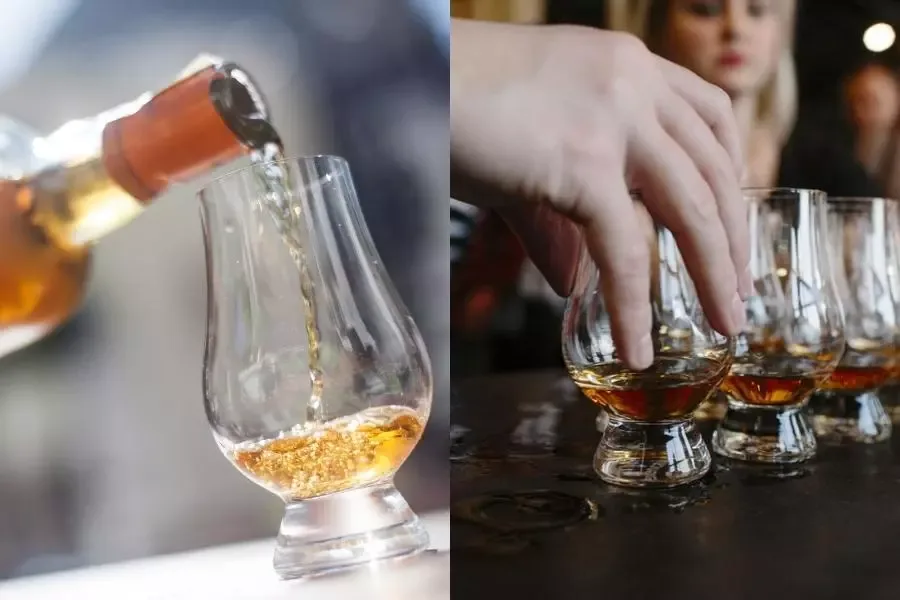
Walk into a whisky tasting and you'll usually see small tulip-shaped glasses on the table. It's fair to wonder why, when a tumbler would do. The short answer: the glass doesn't change the liquid itself, but its shape genuinely does affect how — and how quickly — aroma molecules reach your nose.
A narrowing rim gathers the aroma
Nosing glasses share a common structure: wide at the base, narrowing toward the rim. The wide bowl gives the liquid more surface area to contact air, helping aroma develop, while the narrowing rim keeps those rising molecules from scattering and funnels them toward the nose instead. The Glencairn glass is the best-known example — designed with input from Master Blenders at several of Scotland's largest whisky companies, drawing on the traditional copita-style nosing glass. Its proportions were built around a standard 35ml pour with room left over for adding water.
Why a wide-rimmed glass works against you here
A tumbler or rocks glass, by contrast, has a wide open rim that lets aroma disperse sideways rather than concentrate. Alcohol vapour often hits the nose first and can mask more delicate notes. That doesn't make a tumbler the "wrong" glass, though — for drinking over ice, or as a highball, a wide rim is actually the more natural choice. Glass shape isn't really a right-or-wrong question; it's a tool suited to how you intend to drink.
How a nosing glass differs from a wine glass
A wine glass is tulip-shaped too, but with a much larger bowl and a comparatively wider rim. That's good for showing off wine's layered fruit and floral notes, but on a spirit as strong as whisky, the wider opening can let alcohol vapour dominate and mask subtler aromas. A nosing glass is smaller with a narrower rim specifically so it can concentrate aroma efficiently even from a small pour.
The glass isn't the whole story
That glass shape affects how aroma is delivered is fairly well established, but it would be a stretch to say one expensive glass dramatically transforms a tasting on its own. Cleanliness of the glass, room temperature, how much water you've added, and how close or far you hold your nose all play a part too. A nosing glass is a tool that makes those other variables easier to control — swapping the glass alone won't automatically fix everything else.
Which glass, and when
- Comparing subtle aromas, or a first taste from a new bottle: a tulip-shaped nosing glass
- Casual drinking, with ice or water: a tumbler or rocks glass
- Comparing several drams side by side: the same glass shape for all of them
A glass isn't a tool that hands you the right answer — it's an aid that helps you hear the aroma more clearly. Whichever glass you use, tasting consistently in the same glass, again and again, matters more than which shape you picked.
A comparison protocol, not a claim of a completed test
This page explains glass selection; it does not report a tasting we performed. To investigate a difference, write down the product, glass shapes, equal pour sizes, room conditions and observation time. Label the glasses A and B and change only the glass, not the whisky or water addition.
| Stage | What to record | What not to conclude |
|---|---|---|
| Before comparing | Glass cleanliness, pour and temperature conditions | That price predicts performance |
| First pass | Aroma clarity, irritation and ease of use separately | That the preferred glass changes liquid quality |
| Reverse the order | Whether the impression survives B then A | That one pass proves a universal rule |
| Conclusion | Preference, inconvenience and unknowns | That another person must agree |
Aroma-only observation is possible; repeated drinking is not required. Personal preference is not a laboratory measurement. If order or conditions change the impression, retain that uncertainty rather than selecting only the result that supports your initial expectation.
For general glass categories, use the glassware guide. This article's distinct role is to help readers judge a comparison and its limitations.