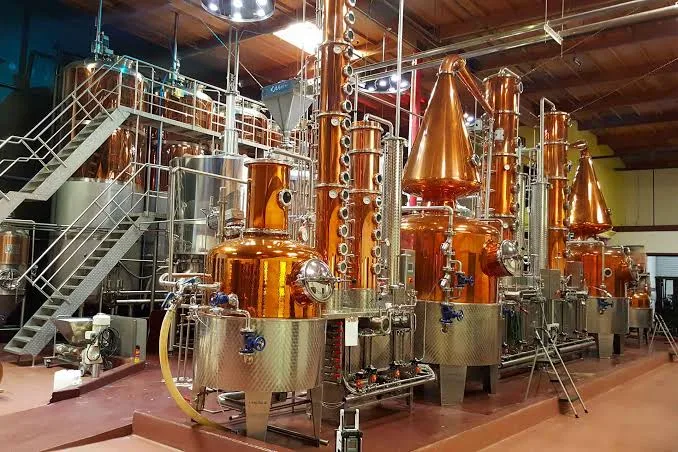
"Made in a pot still" gets used almost as shorthand for quality. But what that phrase actually means, and how it differs from a column still, is hard to tell from the label alone. The two stills work in genuinely different ways, and that difference decides what compounds and texture end up in the finished spirit.
A pot still boils one batch at a time
A pot still is a large copper vessel shaped like a kettle. Fermented wash is loaded in and heated from below; alcohol vaporises first, rises through the neck, and is cooled back into liquid through a condenser. Once a run finishes, the still has to be emptied and refilled for the next batch — a slower, batch process, but one where the distiller can judge the cut point for every single run. Scotch single malt and Irish pot still whiskey are both built around this method.
A column still never really stops
A column still (also called a patent still, or continuous still) is a tall vertical cylinder stacked with multiple plates. Wash enters near the top and flows downward, vaporising and condensing repeatedly as it meets heat across the plates, with the alcohol concentration climbing at each stage. Because wash can keep going in while spirit keeps coming out, the process is far more efficient — which is why it's the backbone of grain whisky and bourbon production.
Why weight and purity end up so different
The key variables are how much contact the vapour has with copper, and how pure the alcohol comes out after a single pass. A pot still runs at a comparatively low proof, so more of the compounds that build flavour — fermentation and grain character, congeners — tend to stay in the spirit. A column still's repeated plates refine the spirit more thoroughly, yielding a higher-proof, cleaner result, but usually with fewer of those individual compounds intact. That's the basis for the common shorthand: "pot still means heavier, more distinctive spirit," "column still means lighter, more refined spirit."
Hybrids and exceptions exist too
This split isn't absolute. Some distilleries run hybrid stills — a pot still fitted with a rectifying column — and even among column stills, the number of plates and how they're run can change how heavy the result feels. Still shape matters as well: neck length and lyne arm angle affect how much reflux occurs, which is why pot-still spirit from different distilleries can taste distinctly different even under the same broad method. So it's worth reading "pot still" as one clue rather than a guarantee of a specific flavour — worth checking alongside the ingredients and the cask the spirit went through afterward.
What to check on the label
- Pot still (batch) or column still (continuous)?
- Does the distillery run a hybrid still?
- Could still shape differ from one distillery to another, even under the same method?
- Are other factors that shape weight — ingredients, fermentation length, cut width — disclosed too?
The type of still is a useful first clue to a whisky's character, not a scale for ranking quality.